
Submission
Deadline
October 16, 2026
Judging
Date
November 11, 2026
Winners
Announcement
November 26, 2026

There are no oranges in orange wine. Disappointing, perhaps, if you arrived expecting a bottle of white wine with a citrus makeover.
The colour comes from somewhere far more interesting: the skins of white grapes.
And that small technical detail changes almost everything.
Unlike conventional white-wine production, where grapes are generally pressed and the juice separated from the skins before fermentation, orange wine allows the fermenting must to remain in contact with grape solids. The result is not simply a darker colour. Skin contact alters phenolic extraction, texture, bitterness, astringency and, depending on the regime, oxidative development and ageing potential.
So the more interesting question is not where are the oranges?
It is: what happens when a white grape is treated, at least partly, like a red?
The technique is considerably older than the term.
Georgia provides the most important surviving historical reference point. Archaeological evidence places winemaking in the region as far back as the Neolithic period, around 6000–5000 BC. Traditional Georgian winemaking developed around qvevri, large earthenware vessels buried underground, where grapes can ferment and mature with their skins, seeds, and sometimes stems.
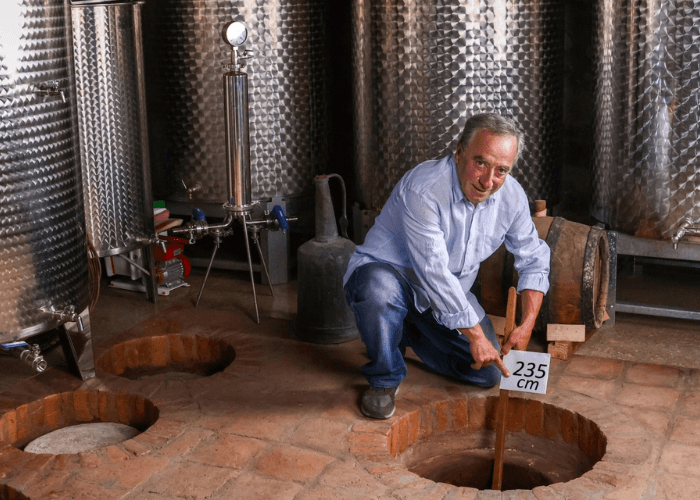
Image showing Traditional Georgian winemaking. Inside the 30-Year Journey of Kardenakhi 7’s Saamo 1987. Also won best wine by quality at London Wine Competition.
The resulting wines, traditionally described as amber wines, can show deep colour, phenolic grip and savoury complexity.
Calling these simply “orange wines”, however, risks imposing a modern category on an ancient tradition. Georgian winemaking developed long before the red-white-rosé classification system familiar today.
The technique is ancient.
The name is not.
For much of modern European wine history, white-wine production moved in another direction.
During the twentieth century, temperature control, clarification, inert vessels and improved oxygen management allowed winemakers to preserve primary fruit and aromatic freshness. Separating juice from skins reduced phenolic extraction and helped create the pale, precise whites that became the benchmark of modern quality.
This was a remarkable technical achievement.
But it also established an aesthetic expectation: white wine should be fresh, clean, pale and fruit-driven.
Skin contact challenged that assumption. Instead of treating grape skins as something to remove, a small group of producers began considering them a source of structure.
The contemporary revival became particularly important in the hills of Collio, on Italy's border with Slovenia.
Two names are central: Joško Gravner and Stanko Radikon.
During the 1990s, both producers moved away from conventional white-wine production and towards prolonged skin contact, producing wines from varieties such as Ribolla Gialla that were darker, more tannic, oxidative and structurally complex than the mainstream whites of the period.
Their philosophies were not identical.
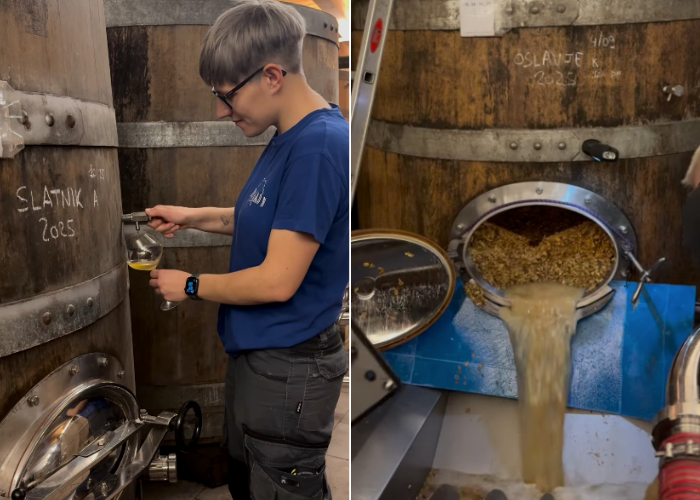
Image: Radikon
Radikon developed a distinctive style around extended maceration and maturation in large oak vessels. His wines demonstrated that a white grape could produce something with the texture, concentration and ageing potential normally associated with red wine. His son Saša later continued and developed the estate's approach.
Gravner's journey was even more radical. After experimenting with modern technology, he travelled to Georgia and became increasingly convinced that traditional qvevri offered a different path. He subsequently adopted buried clay vessels and long maceration as central elements of his production.
The significance of Gravner and Radikon was therefore greater than their individual wines.
They helped transform skin contact from a historical survival into a modern intellectual challenge to conventional white-wine making.
They were not asking how to make white wine darker.
They were asking whether white wine had become too narrowly defined.

Image: Joško Gravner is regarded as a pioneer of modern orange winemaking in Collio, northeastern Italy, a region where wines made with extended skin contact have been part of the local tradition for centuries.
The answer lies largely in phenolics.
During maceration, compounds are extracted from grape skins, seeds and, where included, stems. These phenolic fractions contribute colour, bitterness and astringency, while their extraction depends on variety, temperature, alcohol, pH, time and mechanical handling.
This is why orange wine is an imperfect category.
A lightly macerated Chenin Blanc may remain pale, aromatic and fresh. A long-macerated Ribolla Gialla can become deeply amber, tannic and savoury. A Georgian Rkatsiteli from qvevri may show a different combination of phenolic structure and oxidative development.
The wines share a method, not necessarily a sensory profile.
And “tannin” needs some precision. Tannin is not simply bitterness. Astringency is primarily a tactile sensation produced by interactions between tannins and salivary proteins, while bitterness is a taste perception.
A skin-contact wine can therefore be bitter without being highly astringent, or strongly tactile without being particularly bitter.
The best examples integrate these sensations with acidity, fruit and alcohol.
More extraction does not automatically mean more complexity.
Sometimes it simply means more extraction.
Maceration can last from hours to weeks or, in traditional approaches, considerably longer.
Temperature, movement of the skins and inclusion of stems all affect extraction.
Oxygen adds another layer.
Modern white-wine production generally seeks to limit oxidation, preserving fresh fruit and delicate aromas. Skin-contact wines can take a different approach, and controlled oxygen exposure may contribute notes of dried fruit, nuts, tea, and savoury complexity.
But there is a fine line.
Excessive oxidation can flatten fruit and freshness. Volatile acidity, reduction and Brettanomyces can similarly move from complexity to fault depending on intensity and context.
This is where the mature wine drinker needs to resist the romantic language surrounding “natural” or “minimal-intervention” wine.
A wine can be unconventional without being complex.
It can be technically imperfect without being profound.
The useful question is whether the character is integrated into the wine or simply dominates it.
The two are often confused.
Orange wine describes primarily a vinification technique: significant skin contact with white grapes.
Natural wine is a broader and less formally defined philosophy that may involve organic or biodynamic farming, spontaneous fermentation, low sulphur and minimal cellar intervention.
There is substantial overlap, but neither requires the other.
The same applies to amphora.
Clay has become almost synonymous with contemporary orange wine, but skin contact can take place in stainless steel, concrete or oak. Conversely, a wine can be fermented in amphora without prolonged skin contact.
The vessel matters.
But clay is a tool, not a quality guarantee.
For Asian wine drinkers, orange wine has a particularly interesting gastronomic dimension.
Many Asian cuisines combine chilli, sweetness, acidity, fermentation, umami, herbs, bitterness and spice in ways that can challenge conventional Western pairing formulas.
Think of Korean fermented foods, Japanese miso, Thai herbs and chilli, Vietnamese sweet-sour flavors, Sichuan spice, or Indian dishes built around mustard, tamarind, cumin and smoke.
Phenolic structure gives a wine another way to respond.
Texture can stand up to richer preparations; savoury character can complement fermentation and umami; bitterness can echo herbs and bitter vegetables.
But this is not a universal pairing formula. High tannin can intensify chilli, excessive bitterness can clash with certain ingredients, and oxidative wines may overwhelm delicate seafood.
The real advantage is structural: skin contact gives the sommelier another dimension with which to approach complex cuisines.
For an increasingly sophisticated Asian wine market, that is more significant than the novelty of the colour.
What began as an ancient method survived in Georgia and was reinterpreted by producers such as Gravner and Radikon before becoming associated with the natural-wine movement and spreading far beyond Italy and Slovenia.
Today, producers from Australia and Austria to the United States and South Africa are experimenting with skin contact using local varieties, different vessels and widely varying maceration periods.
The result is not one style but a spectrum.
And perhaps that is the lasting value of orange wine.
It reminds producers that phenolics are not simply something to remove. It reminds consumers that texture can be as important as aroma. It demonstrates that controlled oxidation can sometimes add complexity. And it challenges the assumption that white wine must be pale, fresh, aromatic and immediately accessible.
White grapes can produce wines with tannin.
They can be savoury rather than overtly fruity.
They can evolve through oxidative maturation.
They can occupy a structural space between the conventional expectations of white and red wine.
That is why orange wine deserves to be taken seriously — not because it is ancient, fashionable or unusual, but because it has expanded the conversation about what white grapes can become.
The colour is simply the most visible consequence.
The real story happens in the mouth.
And the oranges? They were never the point.
Header image: Joško Gravner
Also Read:
Rethinking Wine Through Asia’s Emerging Regions
Crafted in Italy, Curated for Asia: Meet Fishing Cat Wines
Get your wines evaluated by leading Asian importers, distributors, retailers and trade buyers. Receive detailed feedback on quality, value and packaging and discover how your brand can improve its market potential in Asia.