
Submission
Deadline
October 16, 2026
Judging
Date
November 11, 2026
Winners
Announcement
November 26, 2026
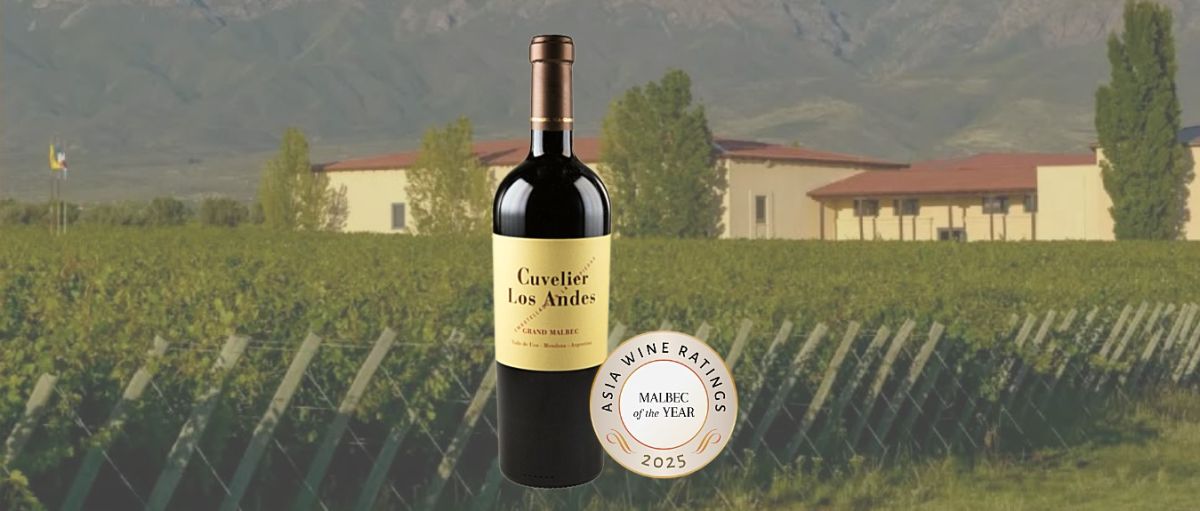
Innovation meets heritage in the heart of Mendoza, where Cuvelier Los Andes, a family-owned estate backed by more than two centuries of Bordeaux winemaking tradition, has carved out a place among Argentina’s most distinguished producers. Their 2019 Grand Malbec, a vintage that marks a decade since the estate fully transitioned to organic and biodynamic viticulture, was awarded “Malbec of the Year” at the 2025 Asia Wine Ratings.
To understand what makes the wine, the estate, and the philosophy behind them so exceptional, we sat down with Baptiste Cuvelier, President of Cuvelier Los Andes. In this candid conversation, he talks about the origins of the estate, the deliberate merging of Bordeaux Grand Cru precision with the distinct terroir of Valle de Uco, and the vision guiding the brand’s expansion across Asia and beyond.
Edited excerpts from the interview.
It can all be summed up in one sentence: we wanted to create the Argentinian cousin of Château Léoville Poyferré. We set out to make wines that can age beautifully for 20, 30, even 40 years—exactly what we do in Bordeaux. Rather than reinventing the wheel, we replicated the same model: same vineyard size, 100 % estate-grown fruit, very low yields, and a winemaking philosophy rooted in precision. Cuvelier Los Andes has 56 hectares under vine—virtually identical to Léoville Poyferré. We chose that size deliberately because it’s the scale we know how to manage with absolute precision. That structure is what allows us to produce the perfect grapes for long-ageing wines.
There are huge differences between Bordeaux and Mendoza—think climate, grape variety, irrigation, and so on. That’s why we partnered with Argentinian enologists and agronomists who have spent their lives in Valle de Uco, from day one. They understand Malbec (we barely grow it anymore in Bordeaux). And above all, they master irrigation—which is strictly forbidden in Bordeaux Grands Crus. We arrived with a crystal-clear vision, but zero practical knowledge of Malbec or local conditions. Without our Mendoza experts, we would have made costly mistakes and lost decades.
Mendoza is essentially a high-altitude desert: 200 mm of rain per year, intense sunshine and evident day-to-night temperature swings, thanks to the Andes. The result? Grapes with skins three times thicker than in Bordeaux. Hence the deep colour, powerful tannins and explosive aromatics typical of the region. Our biggest challenge is preserving natural acidity. The cool nights help enormously with this. 2019 was a relatively cool vintage (my personal favourite), giving us extra freshness and acidity. Hotter years produce bolder, more Californian-style wines; 2019 feels closer to Bordeaux—elegant, balanced, and dangerously drinkable already!
Our cover crops bring plenty of benefits. Firstly, to preserve the acidity, these crops help to control temperature in the vineyard in summer, because the more heat, the more the grapes consume their inner acidity. For wines meant to age 20–30 years, correcting the acidity of the wines in the tanks by adding tartaric acid is not an option, as it never integrates well and the wine will fall apart in few years. So the acidity must come from the grapes. Cover crops absorb the sun's heat, prevent reflection from the soil gravels back to the clusters. This helps control their temperature and therefore preserve the acidity in the grapes. But that is just one advantage.
When we arrived, the soil was rock solid with almost no organic material; around 0.5%. And because of the extreme dryness of the air, that very low proportion of organic material in the soil tended to mineralize. Another issue on our hands was the fact that when it rained, the water was not penetrating the soil and, even worse, was washing it away. Our cover crops roots are now fixing our soil while also enabling the rainwater to penetrate along with their roots. We planted chicory and barley to perforate the crust. After 15 years now, we have no more soil erosion; we have been able to reduce irrigation because every millimeter of rain is accounted for in our irrigation plans; and—probably what I am most proud of—our former desertic soil is now black, smells of good humus and includes over 2.5% of organic material.
For fertilization we planted lupine, a green fertilizer that fixes atmospheric nitrogen and makes it available through its roots, for the plants including the vines. Cover crops also increase root competition near the surface, forcing vines to grow deeper roots, enhancing the minerality in our wines. Finally and probably what we most taste in the wines, is their contribution to the aromatic complexity of the wines. Some of these crops are also very aromatic, I can name a local type of mint, what we call here polleo verde, but we also have thyme, fennel and arugula that are growing naturally. We planted lavender all around the winery and roses at the end of our line vines. They all add aromatics that literally stick to the grape skins and become part of the wine. The minty character in our 2019 Grand Malbec directly comes from this local mint. Finally, cover crops help rebuild biodiversity, making the vineyard an environment where pests or fungus cannot easily settle or destroy everything. Throughout the years we have also been able to reduce our fungicide sprayings to an average of less than three times per year.
First of all, grapes are the raw material for wine. The better the grapes, the better the wine—that’s the whole truth. That’s why we are 100 % estate-grown, from a small 56-hectare vineyard worked at very low yields—around 6 tons per hectare (40 hl/ha), comparable to Bordeaux Grand Cru levels. That’s less than one-third of Mendoza’s average yield, and it makes all the difference. We harvest by hand into small crates to preserve the integrity of the fruit and avoid any crushing or damage. Then we double-sort. First by cluster, then berry by berry, to ensure only good grapes enter the winery.
To begin with, it’s an economical decision—I don’t have to buy industrial yeast. Native yeasts are everywhere, we breathe them in every day. Because we farm organically and biodynamically, we don’t use aggressive systemic fungicides that would kill them, so they stay alive on the grape skins and arrive in perfect condition at the winery. Native yeasts bring real complexity: dozens of different strains kick off fermentation at the same time, each contributing its own aromatic profile as they compete. Eventually one strain dominates, but that initial “fight” creates layers of nuance you simply don’t get with a single commercial yeast.
On top of the aromatic richness, Mendoza grapes naturally have very high sugar levels, which can push alcohol up. Industrial yeasts are selected to convert sugar into alcohol as efficiently as possible. Native yeasts, on the other hand, are generally less efficient. They need more sugar to produce the same amount of alcohol , so they actually help us keep final alcohol levels lower and the wines better balanced.
Fermenting our very best grapes directly in new French oak barrels delivers stunning results. It ensures powerful yet perfectly regular extraction and, above all, it softens and rounds those big, bold Mendoza tannins far more quickly and harmoniously than fermentation in a tank ever could. That’s probably the real secret behind our top wines: they are built to age gracefully for 20, 30 or even 40 years, yet they remain remarkably approachable and enjoyable when young. The 2019 Grand Malbec is a perfect example. After just six years it is still in its childhood, but it already drinks beautifully.
Our philosophy is simple: add nothing in the vineyard and nothing in the winery. If you grow the right grapes, everything you need is already there. That said, we do a huge amount of gentle, mechanical work to coax every last bit of goodness out of those thick Mendoza skins. In tank, we perform six pump-overs a day for soft, regular and consistent extraction. In barrel (where pump-overs are impossible), we manually rotate each one five or six times a day. It’s labour-intensive, but absolutely crucial: we’ve invested everything in producing concentrated fruit, loaded with ripe aromatics, phenolics and tannins, and we have to get all of that into the wine.
We also keep fermentation temperatures tightly controlled, never letting a tank go above 25 °C (about 78 °F). That protects the primary fruit aromas from being “cooked” and deliberately slows fermentation, giving us a much wider window for gentle, progressive extraction.
It’s an extremely balanced vintage. It also marks our tenth year of fully organic and biodynamic farming, and I believe it really showcases all the qualities we’ve been talking about. The wine is harmonious, lively, and opens up beautifully, which is probably why it won the competition. Personally, I think the 2018 and 2020, which are also outstanding vintages, are even greater wines but we’ll only fully appreciate that in twenty years’ time. Right now, the 2019 is simply the most open and enjoyable of the three.
Well, it would be a lovely introduction to Argentine wine, but let’s be honest: wine is just wine. In my culture, my upbringing, my faith: wine is liquid food. That’s what we Latin people drink every day. It belongs on the table at lunch and dinner, and as nobody should hurt his health or/and his wallet twice a day, that is exactly why we pour so much passion and effort into making truly high-quality wines, yet we still price them reasonably despite their cost of production.
So, to answer your question: I don’t want anyone overthinking my ‘interpretation’ of Malbec. I just hope that when someone opens a bottle of Cuvelier Los Andes, they simply feel a moment of real pleasure and joy.
Our primary market is Argentina itself. In just 27 years, after starting with completely virgin land, Cuvelier Los Andes has already become a reference for quality, consistency and value for the money, and that is already an incredible achievement. I’m convinced that once you earn that recognition at home, the recognition in the rest of the world will follow.
For exports, the two biggest organic markets for Argentine wine are the United States and Brazil and these are our 2 main export markets. France has been an absolutely outstanding market for us, and Hong Kong and Singapore currently lead the way In Asia,
Of course! Mainland China, Thailand, Taiwan, Japan, South Korea, you name it. It’s literally the other side of the planet for us, so regular visits aren’t easy!
What resonates most with Asian buyers is undeniably the story and the direct link to Château Léoville Poyferré. That’s why I always expected our Bordeaux-style blends to sell better. I think they are the perfect match for the finesse and complexity of Chinese cuisine, which I absolutely love. But, surprisingly, it’s our pure Malbecs that sell the most in Asia. Go figure!
Argentina has so much more to offer than just Malbec, the same way Uruguay has more than Tannat and Chile more than Carmenere. But if Malbec is what makes people happy over there, then I’m thrilled. As long as they enjoy the wine, that’s all that matters to me.
Header image sourced from Cuvelier Los Andes (Instagram).
Get your wines evaluated by leading Asian importers, distributors, retailers and trade buyers. Receive detailed feedback on quality, value and packaging and discover how your brand can improve its market potential in Asia.